

The Short Answer: A built-up roof system is a flat roofing assembly built on site from alternating layers of bitumen and reinforcing ply sheets, topped with gravel, mineral granules, or a reflective coating. BUR handles heat, standing water, and foot traffic well, so it holds up on low slope roofs across Georgia and the South Carolina Low Country. Roof structure and the installation approach are the two things to plan around, and a contractor who works with BUR will sort both out early.
Most people know it as a tar and gravel roof, and you’ve almost certainly walked under one without giving it a thought. This roofing system has covered flat roofs on schools, warehouses, and downtown storefronts for more than a century, and plenty of it is still in service around Savannah.
How a Built-Up Roof System Is Layered
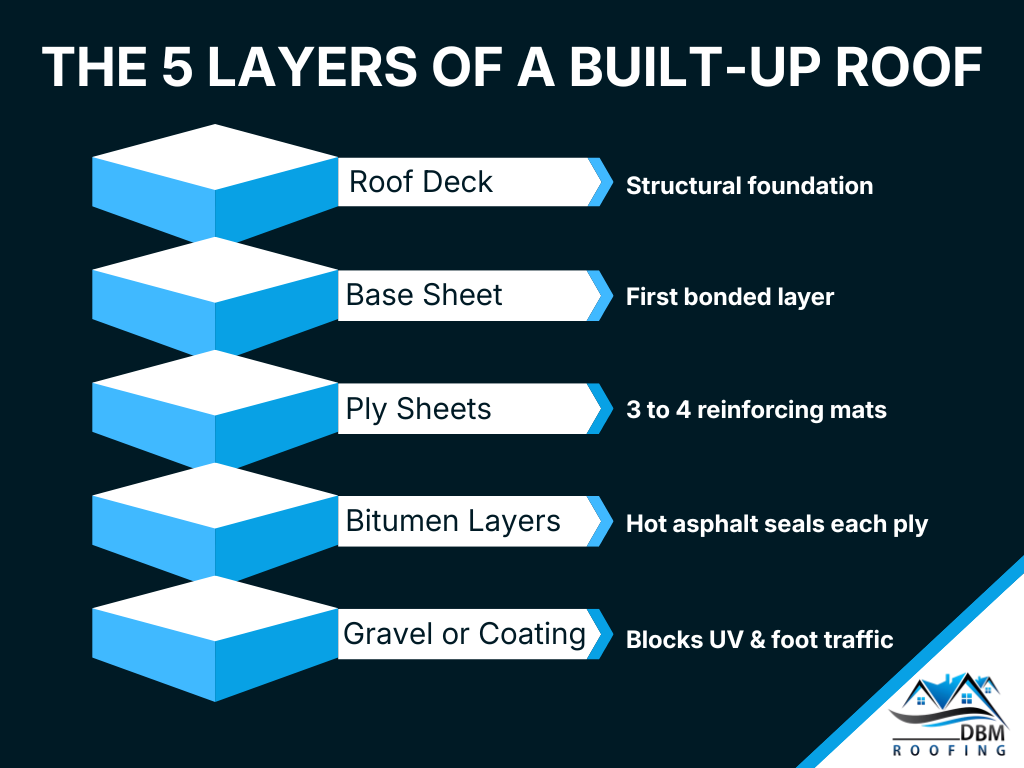
A BUR roof gets assembled in place, layer by layer, directly on the roof deck. Nothing arrives finished, which is why installation quality matters so much.
It starts with a base sheet, fastened or adhered to the deck or to a cover board. Ply sheets come next, usually three or four reinforcing felts or fiberglass mats, each set into a layer of bitumen. That bitumen is hot asphalt, coal tar, or a cold-applied adhesive, and it does the actual waterproofing. The final step is surfacing: loose gravel, embedded mineral granules, a mineral-surfaced cap sheet, or a reflective coating.
Stack all of that together and you have a roof membrane several plies thick. If one layer takes damage, the layers beneath it are still working. That redundancy is the whole argument for BUR, and it’s why building owners with large flat roofing areas keep specifying it decades after lighter systems arrived.
Why BUR Works in the Southeast
Our climate is hard on roofing material. Between the summer sun, the storms that roll through most July afternoons, and humidity that never fully lets up, a flat roof here has a shorter life than the same roof somewhere milder.
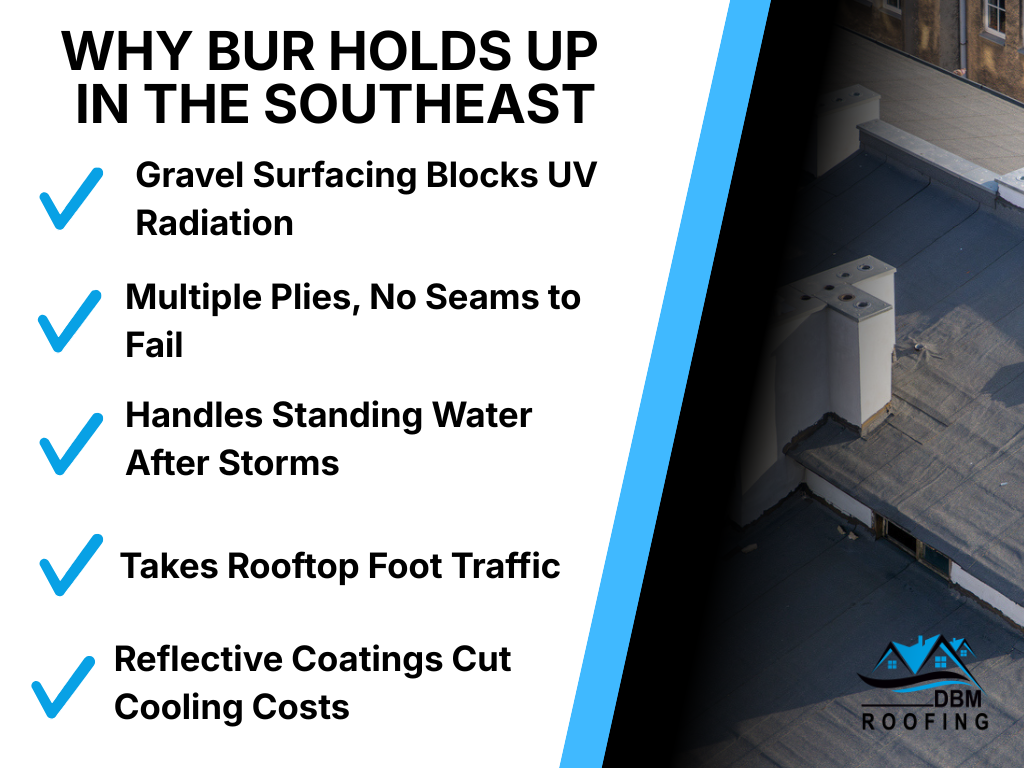
Heat and UV do the slow damage. Bare membrane bakes, and the gravel or mineral granules on a BUR roof stop UV radiation before it reaches the bitumen membranes underneath, which slows the drying and cracking that ends thinner systems early. A reflective coating brings the surface temperature down further, worth real money on a building running air conditioning nine months a year.
Water is the other half of the equation. Low slope roofs pond, and that’s simply what they do. A multi-ply roofing system with continuous bitumen between every layer has no seams to fail the way a single-ply roof can, and that shows up when water sits for three days after a storm.
Traffic matters more than most building owners expect. Rooftop HVAC means somebody is up there several times a year, walking the surface and dragging tools around, and a gravel-surfaced BUR system absorbs that wear better than a thin membrane does. There’s a wind argument as well: a heavy, fully adhered assembly with gravel on top gives a coastal storm less to grab than a mechanically attached membrane.
What to Plan For Before You Choose BUR
A built-up roof rewards good planning, and roofing professionals sort a few things out early so the project runs clean.
Start with the roof structure. A built-up roofing system with gravel surfacing carries real weight, so the deck and framing underneath need to support it. That’s a quick check on most commercial buildings, and on an older property it tells us early whether BUR or a lighter assembly fits better.
The installation process is worth understanding too. Hot asphalt calls for kettles on site and a bit more schedule than rolling out a single-ply roof, which takes coordination on an occupied building or a tight downtown lot. Cold-applied adhesive systems suit those jobs well when a quieter, lower-odor install matters, and we’ll talk through which approach fits your building before work starts.
Drainage rounds out the list. Because water can travel between plies, a roof with good drainage design and clearly detailed penetrations stays easier to maintain across its whole service life. Getting that right during design is what keeps a BUR roof performing decades later.
BUR vs. Other Flat Roofing Options
BUR is one of several ways to cover a low-slope roof, and the right choice depends on the building, the budget, and what’s already up there.
Modified Bitumen Roofing
Modified bitumen roofing is the closest relative. Its sheets are manufactured with polymers like atactic polypropylene worked into the asphalt, giving you similar layered protection with a faster install and less weight.
TPO and PVC
TPO and PVC are single-ply membranes. They’re lighter, more reflective, and quicker to install, but they depend entirely on welded seams and don’t handle foot traffic the way a gravel surface does.
EPDM
EPDM is a rubber membrane that installs easily and has a long track record. Standard EPDM is black, though, and black absorbs heat, which is worth weighing in Georgia.
Roof Coating Over an Existing BUR
One option people overlook: if an existing BUR roof is aging but the structure is sound, a roof coating can add years of service life and UV protection without a tear-off. Worth pricing before you assume you need a full replacement.
What Determines Service Life
A properly installed BUR system will give you 20 to 30 years, and sometimes considerably more. Three factors move that number in either direction.
- Installation quality: Bitumen has to be applied at the right temperature and the right rate. Too cool and the plies never bond properly. Too hot and the asphalt is damaged before the roof is finished. This is where a crew’s experience either shows up or doesn’t, and it’s not something you can inspect from the ground afterward.
- Flashing details: Leaks start at edges, curbs, drains, and pipe penetrations, not in the middle of the field. How carefully a crew handles those transitions tells you more about the roof’s future than the ply count ever will.
- Maintenance: Keep the drains clear, check the surfacing after a bad storm, and address small problems while they’re still small. A gravel roof that’s lost surfacing in patches will fail years ahead of one that gets looked at regularly.
Your Best Built-Up Roof
We’ve spent over ten years installing, repairing, and maintaining roofs across central and southern Georgia and the South Carolina Low Country. Our crews know what this climate does to a flat roof, and we use quality materials and proven methods on every built-up roofing and commercial roofing project.
When you work with DBM Roofing, you get:
- A single, accountable crew from start to finish
- Honest, itemized pricing with no surprise fees
- Straight guidance on repair, recover, or replacement
- Financing and insurance support for larger projects
- A long-term partner for maintenance and future work
If you’re weighing a BUR system against other flat roofing options, or need commercial roofing repair on a roof you already have, contact DBM Roofing for a free estimate. We serve Savannah, Richmond Hill, Brunswick, Statesboro, Hinesville, Mount Pleasant, North Charleston, and the surrounding area. We’ll walk your roof, answer your questions, and tell you what it needs and nothing it doesn’t.
Frequently Asked Questions
How long does a built-up roof last?
Twenty to thirty years is the normal window, and well-maintained BUR roofs often run longer. Installation quality drives that number more than the specification does. A four-ply system with the flashings detailed correctly outlasts a five-ply job with sloppy edge work every time.
Can a built-up roof go on a house?
On the right house, yes. BUR is built for flat and low slope roofs, so it isn’t going over a pitched shingle roof. Homes with flat sections, a modern flat design, or a low-slope garage or addition can be candidates. Most BUR work in this region, though, is on commercial buildings.
Is a BUR roof good for hot, humid climates?
That’s one of its stronger arguments. The gravel or granule surface shields the bitumen from UV radiation, and the layered construction handles water that sits after a storm. A reflective coating cuts heat gain further, which helps through a Georgia summer.
What does a built-up roof cost compared to single-ply?
More up front, generally. You’re paying for the labor of building the layers on site rather than rolling out a finished membrane, and what you get back is a thicker roof system with redundancy built in. Price a couple of options and weigh expected service life against the install number.
Do you have to tear off the old roof first?
Not always. If the existing roof is sound and the structure can carry the added load, a recover or a coating may be enough. Wet insulation or a saturated deck means tear-off is the only responsible option, and a moisture survey answers that before anyone commits to a scope.
How do I know if my flat roof is leaking?
Ceiling stains are the obvious sign, though water usually travels before it shows itself. Blisters, bare patches in the surfacing, ponding that lingers days after the rain, and open seams at the flashings are all worth a call. Caught early, most stay inexpensive repairs.